Send us a file with no background, at least as big as the print, and nothing in it you can't live without losing. Here's exactly what that means, in the order it matters.
(Print shops: link this page from your order form or quote email. Copy any of it. Swap the targets for your own.)
Customer files arrive in every shape and size.
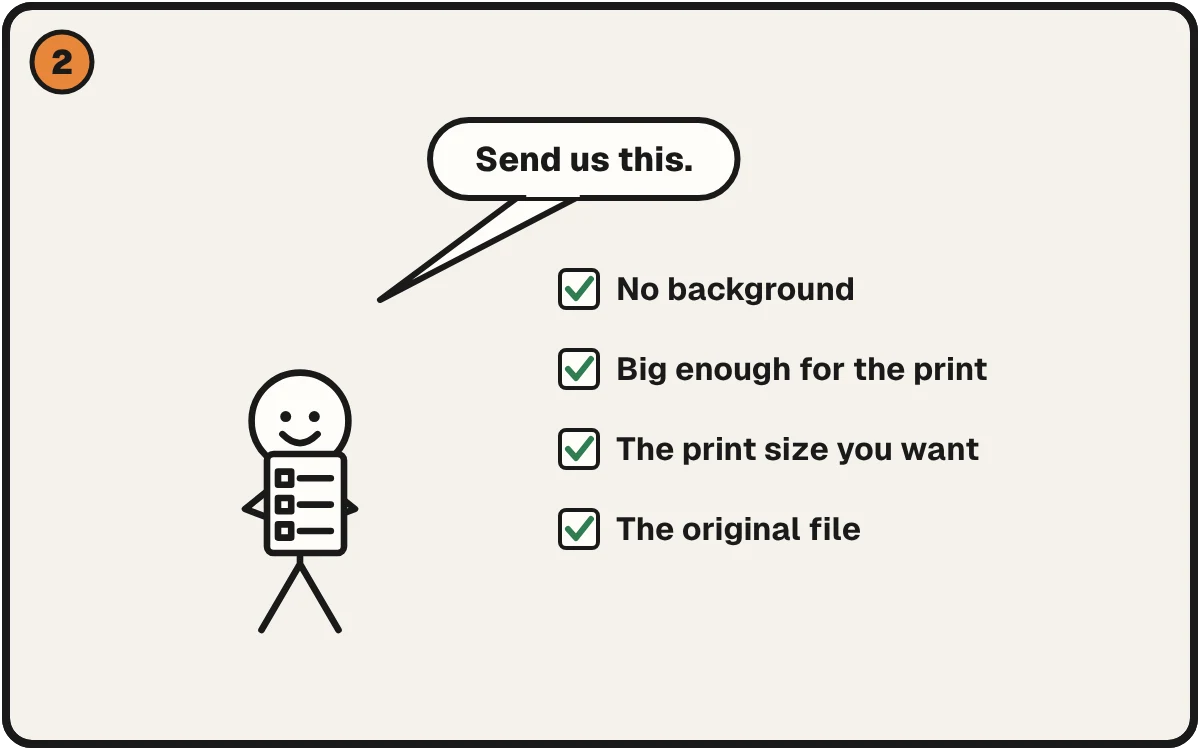
One plain page tells customers exactly what to send.
The file comes in right, and it prints right the first time.
1. No background behind your design
If there's a white or colored box, it may print. Save with a transparent background (PNG). If you're not sure, send us the original and we'll sort it.
2. Big enough for the print
A small file stretched to a big print looks soft. Quick math: pixels across ÷ inches wide you want = sharpness. Aim for 300. 250 to 300 is the range we work in, depending on the size and type of artwork. Phone screenshots and web images are usually too small. If it's all you have, send it anyway and tell us the size. We'll tell you before we print.
3. The size you'll actually print
Tell us the size and where it goes: chest, full front, back, sleeve. Different spots have different limits.
4. Soft edges and glows
Soft shadows and glows can print as a pale haze or a box. If your design has them, tell us. There's a fix.
5. Fine lines and tiny text
Hairlines and very small letters can fill in or fall off. Make them bolder if you can, or ask us.
6. Fonts
Send the font file, or convert text to outlines if you know how. If you don't, send a PDF.
7. What to send us
- The original design file if you have it (the one you worked in), not a screenshot
- A PNG with a transparent background
- A PDF if it's built in Canva (choose PDF, then the Print preset)
- The print size you want
Not sure your file is OK?
Check it free in seconds. It gives you a pass or fail with the fix next to anything that fails. No signup. You can send the result to us along with the file.
Why we ask for this
Across thousands of orders, the same things were wrong with the file before most of them: a background, a size too small, an edge that wouldn't hold. None of it is the customer's fault. It's just what we need to see before a run.